Monday, 3 September 2012

Computer Parts How to Control | Computer Part Problem | Computer Keyboard Problem | computer keyboard | computer keyboard problem | keyboard problem | keyboard | Mouse | Computer Mouse Problem | computer mouse problem | mouse problem | keyboard and mouse


KEYBOARD AND MOUSE  SAFETY

 Keyboard/Mouse
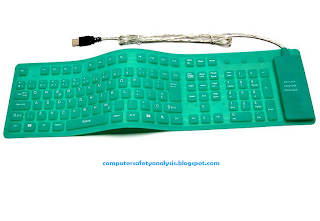


1)Ensure that the retractable legs on your keyboard are pulled back, allowing the keyboard to lay flat.
2)Use a keyboard with a wrist rest - these can also be purchased separately - these wrist rests really do work and greatly decrease fatigue and strain.
3)Your mouse should fit comfortably and naturally in your hand without any need to move any of your fingers to reach a button.
4)Ensure that the contacts inside your mouse are clean to allow for smooth use
5)Keyboards and mice should be regularly disinfected as they are a breeding ground for all sorts of bacteria.
6)Using the seating guidelines above, your keyboard should be the correct distance from you.


Tips

1)Your feet should not be dangling, but flat on the floor. If this is not possible, a footrest is recommended. Your knees should be slightly higher than your hips.
2)A chair with lumbar support is the optimum arrangement, if this is not available, back cushions can be obtained - even a rolled up towel can offer some support.
3)Your back should be firmly supported by the back rest.
4)Adjust the seat so that you can fit 3 fingers between the front of your seat and the back of your legs
5)When extending your arms to the keyboard, your wrists should be parallel with your elbow, this minimizes strain on the muscles of your arm.
6)The top of your monitor should be level with your eyes, or just slightly below eye level. The monitor should be approximately 50 - 70cm (19" - 27") from your eyes.
7)Rest your wrists and hands when you are not typing, don't keep them in a typing position while reviewing work etc.
8)Use document holders where possible. These should be placed at the same height beside the monitor and the same distance away as the monitor.


Incoming Search Tearm

Computer Parts How to Control
Computer Part Problem
Computer Keyboard Problem
computer keyboard
computer keyboard problem
keyboard problem
keyboard
Mouse
Computer Mouse Problem
computer mouse problem
mouse problem
keyboard and mouse

Sunday, 2 September 2012

Font in Office Programs | Computer Problem

Font in Office Programs

Download The File


    When you find a font that you would like to download, you should select one of the file download locations, click the link, and then follow the instructions in the File Download dialog boxes to complete the download to your hard disk drive.

    You may also want to make note of where you've saved the download to, so that you can easily navigate to it when you install the font through the operating system.

Microsoft Windows XP

  •     On the Start menu, click Control Panel.
  •     In the Control Panel, double-click Fonts.
  •     On the File menu, click Install New Font.
  •     Navigate to the location where you saved the downloaded or unzipped font, and, in the List of Fonts box, click the font you want to add
  •     Click OK.

    Add the font to your computer through the operating system.


Incoming Search Tearms


Font in Office Programs

Computer Worms | Computer Worm | computer worm | What is a computer worm | History of computer worm | history of worm | Type of worm | type of computer worm | Definition of computer worm | definition of worm | Worm | Worms | worm | worms

Definition


     Computer worms are malicious software applications designed to spread via computer networks. Computer worms are one form of malware along with viruses and trojans. A person typically installs worms by inadvertently opening an email attachment or message that contains executable scripts.


History of Worms


  • The first worm to attract wide attention, the Morris worm, was written by Robert Tappan Morris, who at the time was a graduate student at Cornell University.
  • It was released on November 2, 1988
  • Morris himself was convicted under the US Computer Crime and Abuse Act and received three years probation, community service and a fine in excess of $10,000.
  • Xerox PARC


Worms


Worm - is a self-replicating program, similar to a computer virus. A virus attaches itself to, and becomes part of, another executable program; however, a worm is self-contained and does not need to be part of another program to propagate itself.

Worms are a subset of viruses

  1. The differ in the the method of attachment; rather than attaching to a file like a virus a worm copies itself across the network without attachment.
  2. Infects the environment rather than specific objects
  3. Morris Worm, WANK, CHRISTMA EXEC


Morris Worm


  • The Morris worm or Internet worm was one of the first computer worms distributed via the Internet; it is considered the first worm and was certainly the first to gain significant mainstream media attention. It also resulted in the first conviction under the 1986 Computer Fraud and Abuse Act.[1][2] It was written by a student at Cornell University, Robert Tappan Morris, and launched on November 2, 1988 from MIT. The worm was released from MIT to disguise the fact that the worm originally came from Cornell. (Incidentally, Robert Tappan Morris is now an associate professor at MIT.)
  • The Morris worm was not written to cause damage, but to gauge the size of the Internet. An unintended consequence of the code, however, caused it to be more damaging: a computer could be infected multiple times and each additional process would slow the machine down, eventually to the point of being unusable. The Morris worm worked by exploiting known vulnerabilities in Unix sendmail, Finger, rsh/rexec and weak passwords. The main body of the worm could only infect DEC VAX machines running BSD 4, and Sun 3 systems. A portable C "grappling hook" component of the worm was used to pull over the main body, and the grappling hook could run on other systems, loading them down and making them peripheral victims.


Slapper Worm


  • Linux - 2002
  • Exploits a problem in OpenSSL to run a shell on a remote computer, this was done in certain versions of the Apache Webserver that use OpenSSL for for https.
  • Also had code for DDOS
  • Fixes have been issed but is still considered “in the wild”


Incoming Search Tearm

Computer Worms
Computer Worm
computer worm
What is a computer worm
History of computer worm
history of worm
Type of worm
type of computer worm
Definition of  computer worm
definition of worm
worm

worms
Worms
Worm

Computer Virus | Create a computer virus|how to create a shortcut a computer virus | basic computer virus | How to identify virus | Definition of virus | Symptoms of Virus Attack | Computer Virus Timeline | virus | Virus


Definition of Virus


    A virus is a small piece of software that piggybacks on real programs in order to get executed.

    Once it’s running, it spreads by inserting copies of itself into other executable code or documents.


  •     Computer virus have become today’s headline news.   
  •     With the increasing use of the Internet, it has become easier for virus to spread.    
  •     Virus show us loopholes in software.
  •     Most virus are targeted at the MS Windows OS.


Virus :

     A true virus is capable of self replication on a machine. It may spread between files or disks, but the defining character is that it can recreate itself on it’s own with out traveling to a new host.

    There are estimated 30,000 computer viruses in existence.
Over 300 new ones are created each month.
First virus was created to show loopholes in software.


Symptoms of Virus Attack


  1.  Computer runs slower then usual
  2.  Computer no longer boots up
  3.  Screen sometimes flicker
  4.  PC speaker beeps periodically
  5.  System crashes for no reason
  6.  Files/directories sometimes disappear
  7.  Denial of Service (DoS)


Virus through the Internet


    Today almost 87% of all viruses are spread through the internet (source: ZDNet).

    Transmission time to a new host is relatively low, on the order of hours to days "Latent virus".

Computer Virus Timeline


1949

    Theories for self-replicating programs are first developed.

1981

    Apple Viruses 1, 2, and 3 are some of the first viruses “in the wild,” or in the public domain. Found on the Apple II operating system, the viruses spread through Texas A&M via pirated computer games.

1983

    Fred Cohen, while working on his dissertation, formally defines a computer virus as “a computer program that can affect other computer programs by modifying them in such a way as to include a (possibly evolved) copy of itself.”

1986

    Two programmers named Basit and Amjad replace the executable code in the boot sector of a floppy disk with their own code designed to infect each 360kb floppy accessed on any drive. Infected floppies had “© Brain” for a volume label.

1987

    The Lehigh virus, one of the first file viruses, infects command.com files.

1988

    One of the most common viruses, Jerusalem, is unleashed. Activated every Friday the 13th, the virus affects both .exe and .com files and deletes any programs run on that day.
    MacMag and the Scores virus cause the first major Macintosh outbreaks.

Typical things that some current Personal Computer (PC) viruses do


Display a message


Incoming Search Tearm


Computer Virus
Create a computer virus
how to create a shortcut a computer virus
basic computer virus
How to identify virus
Definition of virus
Symptoms of Virus Attack
Computer Virus Timeline
virus
Virus